SEO vs Performance Marketing: Key Differences and Career Opportunities
SEO vs performance marketing is an important topic for businesses that want to improve online visibility and attract potential customers. Both approaches help businesses reach their audiences, but they use different strategies to generate traffic and leads.
Two important areas of digital marketing are Search Engine Optimisation (SEO) and performance marketing. Although both aim to support business growth, they use different methods and require different skills.
Understanding SEO vs performance marketing can help students, job seekers and business owners choose the right approach for their goals. This article explains the key differences, benefits, required skills and career opportunities in both fields.
SEO vs Performance Marketing: Understanding SEO
Search Engine Optimisation, commonly known as SEO, is the process of improving a website’s visibility in organic search results. When people search for information, products or services on Google, SEO helps relevant website pages become more competitive in those results.
For example, a person searching for a digital marketing training programme may compare different websites before deciding which institute to contact. A well-optimised website can help users discover relevant information through organic search.
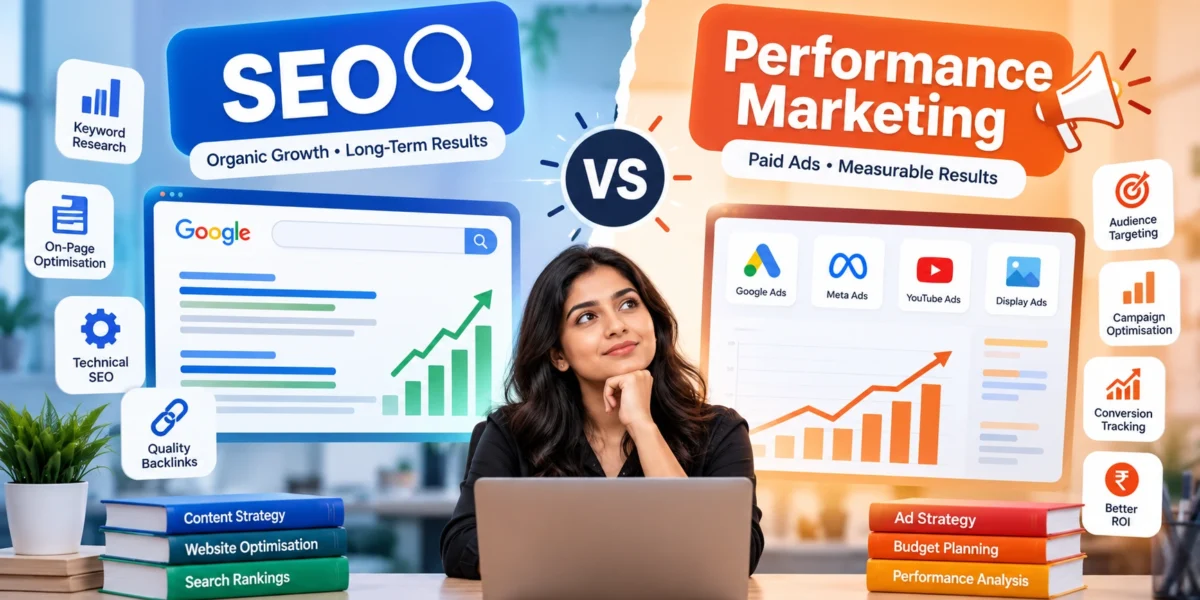
SEO involves several activities, including keyword research, on-page optimisation, technical improvements, content creation and link analysis.
Important SEO Activities
1. Keyword Research
Keyword research helps marketers understand the words and phrases people use when searching online. By understanding search intent, businesses can create pages that answer users’ questions and provide useful information.
2. On-Page SEO
On-page SEO includes improving page titles, headings, content, image descriptions and internal links. These elements help users navigate a website and help search engines understand the page’s subject.
3. Technical SEO
Technical SEO focuses on aspects such as website crawling, indexing, mobile usability and page performance. A technically sound website makes it easier for search engines to discover and process its content.
4. Content Optimisation
Useful blog posts, service pages and guides can answer common customer questions. Content should provide accurate information and offer genuine value rather than repeating keywords unnecessarily.
5. Off-Page SEO
Off-page SEO includes activities that help establish a website’s credibility and visibility outside its own pages. Relevant, editorially earned backlinks can support SEO, although the number of backlinks alone does not guarantee better rankings.
Benefits of SEO
SEO can help businesses attract relevant organic visitors without paying for every click. A useful page may continue receiving search traffic over time if it remains relevant and competitive.
SEO also helps marketers understand search behaviour, website structure and content performance. However, results can take time, and rankings depend on competition, website quality, search intent and other factors.
SEO vs Performance Marketing: Paid Advertising Explained
Performance marketing is a data-driven approach to digital marketing that focuses on measurable campaign outcomes. Depending on the campaign, these outcomes may include website visits, enquiries, registrations, purchases or app installations.
For example, a business promoting a service can run Google Ads to reach people searching for related solutions. The advertiser can monitor campaign spending, clicks, conversions and the quality of the enquiries received.
Performance marketing commonly includes paid advertising platforms such as Google Ads and Meta Ads. It also involves tracking results and using campaign data to improve performance.
Important Performance Marketing Activities
1. Campaign Planning
Before launching an advertisement, marketers need to define the objective, audience, budget and desired action. Clear goals make it easier to evaluate whether a campaign is producing meaningful results.
2. Audience and Keyword Targeting
Marketers select relevant keywords, audiences, locations and other targeting settings according to the advertising platform and campaign objective.
3. Ad Copy and Creative Testing
Different headlines, descriptions, images and calls to action can be tested to understand which messages connect with the intended audience.
4. Conversion Tracking
Conversion tracking helps businesses measure actions such as form submissions, phone enquiries or purchases. Accurate tracking is important because clicks alone do not show whether a campaign is generating business value.
5. Campaign Optimisation
Marketers review campaign reports to identify opportunities for improvement. They may adjust targeting, advertising messages, landing pages or budgets based on reliable performance data.
Benefits of Performance Marketing
Performance marketing allows businesses to measure advertising activity and make decisions using campaign data. Paid campaigns can generate visibility soon after launch, provided they are approved and configured correctly.
However, advertising requires a budget, and results are not guaranteed. Poor targeting, weak landing pages, high competition or an unsuitable offer can reduce campaign effectiveness.
SEO vs Performance Marketing: Key Differences
SEO and performance marketing can both help businesses reach potential customers, but they differ in how traffic is acquired and measured.
1. Organic Traffic and Paid Traffic
SEO focuses on improving visibility in organic search results. Businesses invest in website improvements, useful content and ongoing optimisation to compete for relevant searches.
Performance marketing often uses paid advertisements to reach selected audiences. Advertisers pay according to the platform’s pricing model, such as clicks or impressions, depending on the campaign.
2. Time Required to See Results
SEO generally requires consistent effort, and meaningful improvements may take weeks or months. The timeline varies according to the website, competition and quality of optimisation.
Paid advertising can begin generating impressions and clicks soon after a campaign becomes active. However, generating qualified leads or sales still depends on campaign quality, audience relevance and the website experience.
3. Budget and Investment
SEO involves investment in content, technical improvements, tools and professional time. It does not normally involve paying Google for each organic click.
Performance marketing requires an advertising budget in addition to the time and expertise needed to plan, manage and optimise campaigns.
4. Skills Required
SEO professionals need skills in keyword research, content optimisation, website analysis, technical SEO and organic performance reporting.
Performance marketers need skills in campaign setup, advertising copy, targeting, budget management, conversion tracking and paid campaign analysis.
Both fields benefit from analytical thinking, clear communication and an understanding of customer needs.
5. Performance Measurement
SEO results can be measured through organic impressions, clicks, search visibility, relevant rankings and conversions. Google Search Console is useful for analysing search performance.
Performance marketing results can be measured through advertising spend, click-through rate, cost per click, conversion rate, cost per lead and return on ad spend.
The most useful metric depends on the business objective. For example, a campaign generating many inexpensive clicks may still be unsuccessful if those visitors do not become customers.
SEO vs Performance Marketing: Career Opportunities
There is no single answer because SEO and performance marketing offer different types of work.
SEO may suit people who enjoy researching topics, analysing search results, improving website pages and developing content strategies. Career roles may include SEO executive, SEO analyst, technical SEO specialist and content optimisation specialist.
Performance marketing may suit people who enjoy advertising platforms, testing campaign messages, reviewing numbers and improving measurable results. Potential roles include performance marketing executive, paid media specialist and Google Ads specialist.
Career opportunities and salaries vary according to experience, location, employer requirements and practical ability. Reviewing current job descriptions can help you understand which tools and skills employers expect.
Instead of choosing a field only because it appears popular, consider the type of work you enjoy and the practical experience you can build.
Can You Learn SEO and Performance Marketing Together?
Yes. Learning both areas can help you understand how businesses attract customers through different digital channels.
Imagine a company promoting a training programme. Its SEO strategy may help its website appear in relevant organic search results. At the same time, a paid advertising campaign may reach people who are actively searching for related services.
The company can measure organic performance, analyse paid campaign results and evaluate which channels generate relevant enquiries. This information can help the marketing team make better decisions.
A practical learning plan can include keyword research, on-page SEO, website performance analysis, Google Ads fundamentals, conversion tracking and reporting.
You can practise these activities through sample projects, a personal website or authorised practice accounts. When creating a portfolio, explain your objectives, methods and findings honestly. Do not present sample projects as real client campaigns.
How Practical Digital Marketing Training Can Help
Learning digital marketing concepts is useful, but practical application is equally important. Working through realistic exercises helps learners understand how different tools and strategies are used to solve business problems.
When comparing training programmes, look for opportunities to practise keyword research, website optimisation, campaign planning, analytics and performance reporting. Check whether the programme provides practical assignments, feedback and explanations of real-world workflows.
Learners should also understand how to interpret results rather than simply follow instructions. For example, knowing how to create an advertisement is one skill; understanding why it generates enquiries or fails to do so is another.
If you want to explore structured learning in SEO, paid advertising and related digital marketing areas, visit Digital Marketing Training in Hyderabad by Digital Wiings to learn more about the available programme.
Conclusion
SEO and performance marketing are two important areas of digital marketing, but each follows a different approach. SEO focuses on improving organic visibility and attracting relevant search traffic, while performance marketing uses measurable advertising campaigns to achieve specific objectives.
SEO may be a suitable choice for people who enjoy website optimisation, content and search analysis. Performance marketing may appeal to people who prefer advertising platforms, campaign testing and data-driven decisions.
Both areas require continuous learning, practical experience and the ability to evaluate results. By understanding their differences and practising the relevant skills, you can make a more informed decision about which digital marketing specialisation suits your interests and career goals.
Understanding SEO vs performance marketing can help you choose a specialisation that matches your interests, career goals and business objectives.
Frequently Asked Questions
Is SEO better than performance marketing?
Neither is always better. SEO can support long-term organic visibility, while performance marketing can provide paid reach. The right approach depends on the business objective, budget and target audience.
Is SEO part of digital marketing?
Yes. SEO is a digital marketing specialisation focused on improving a website’s visibility in organic search results.
Does performance marketing require an advertising budget?
Paid performance campaigns generally require an advertising budget. The amount depends on the platform, audience, competition and campaign objective.
Can beginners learn SEO and performance marketing together?
Yes. Beginners can learn the fundamentals of both areas and practise them through structured projects. Practical experience helps learners understand which specialisation they prefer.
What should I include in a digital marketing portfolio?
Include relevant projects such as keyword research, an SEO audit, a content plan, a sample advertising campaign and a performance report. Explain the objective, process and findings, and clearly identify sample work as practice when it is not based on a real client.