Digital Marketing Skills 2026 are becoming increasingly important for students who want to build a career in digital marketing. Digital marketing is changing quickly. A few years ago, learning SEO, social media and online advertising was enough to start building a career. Today, companies expect digital marketers to understand search, paid campaigns, content, analytics, conversion tracking and AI-powered marketing tools.
For students planning a career in this field, the important question is not simply, “Which digital marketing course should I join?” A better question is, “What skills should I learn now so that I can use them in a real marketing job?”
This is where Digital Marketing Training in Hyderabad can become useful for students, freshers and working professionals who want structured learning with practical exposure.
As 2026 moves toward its final months, digital marketing is also moving toward a more integrated approach. Search is no longer limited to traditional Google results. AI-powered search experiences, short-form video, paid advertising, analytics and automation are becoming part of the daily work of digital marketing teams.
What Is Changing in Digital Marketing in 2026?
Digital marketing is not disappearing because of AI. Instead, the role of a digital marketer is becoming broader.
A marketer may need to research keywords, create a landing page, run a Google Ads campaign, analyse traffic in analytics, create social media content and understand why a campaign generated or failed to generate leads.
Google’s current guidance for AI search continues to emphasize the importance of strong SEO fundamentals, crawlable websites and original, useful content rather than special tricks designed only for AI systems.
This means students should not learn digital marketing as a collection of isolated tools. They should understand how the different parts work together.
Why Digital Marketing Training in Hyderabad Is Useful for Students
Hyderabad has a large ecosystem of technology companies, startups, agencies and businesses that depend on online visibility. This creates opportunities across areas such as SEO, paid advertising, social media, content marketing and analytics.
However, simply completing a course does not automatically make someone job-ready.
Students should look for training that allows them to understand how a campaign works from beginning to end.
For example, instead of only learning what Google Ads is, a student should understand:
- How to select a campaign objective
- How keyword research influences advertising
- How ad copy affects clicks
- How landing pages influence conversions
- How conversion tracking works
- How campaign data should be analysed
- How to improve a campaign based on results
This practical approach can make learning much more useful than memorising definitions.
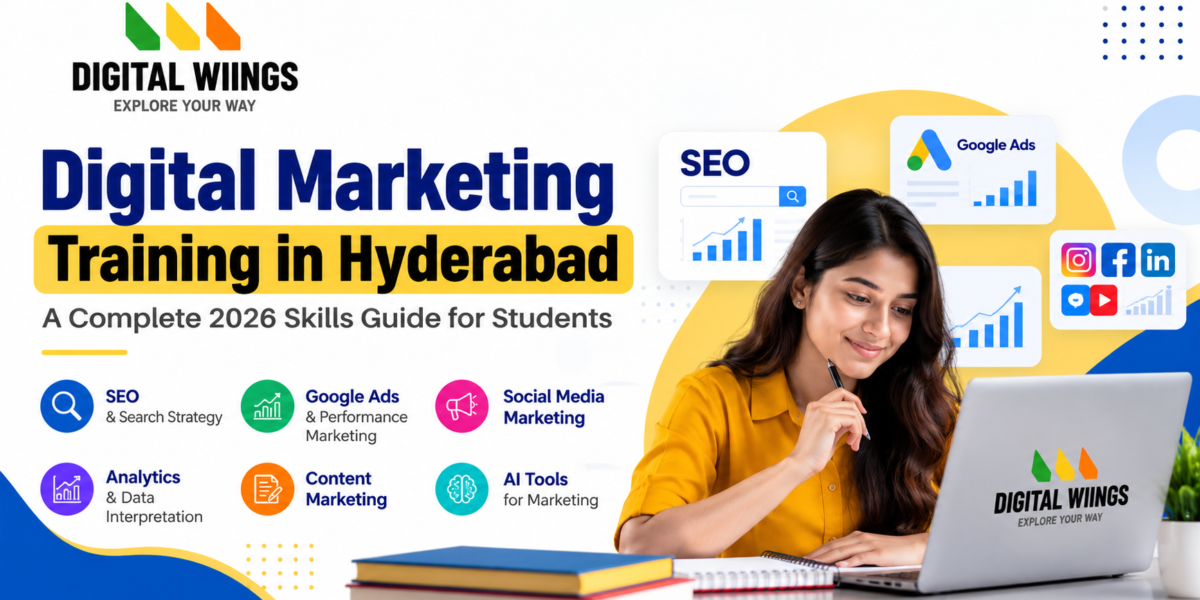
7 Digital Marketing Skills 2026 Students Should Learn
1. SEO and Search Strategy
SEO remains one of the most important foundations of digital marketing.
Students should understand more than simply adding keywords to a webpage. A practical SEO learning path should include:
- Keyword research
- Search intent
- On-page SEO
- Technical SEO
- Internal linking
- Local SEO
- Website structure
- Content optimisation
- Basic schema concepts
- Search Console
- Performance measurement
Search is also becoming more conversational and AI-assisted. That makes it even more important to create content that directly answers genuine user questions instead of producing pages only to target keywords.
Google’s guidance specifically recommends unique, valuable and people-first content and warns against simply rewriting information already available elsewhere.
2. Google Ads and Performance Marketing
Organic traffic is important, but businesses also use paid advertising when they need faster visibility and measurable leads.
A beginner should learn the fundamentals of:
- Search campaigns
- Keyword selection
- Match types
- Ad copy
- Landing pages
- Conversion tracking
- Bidding concepts
- Campaign optimisation
- Remarketing
- Performance reporting
The important skill is not simply knowing how to create an advertisement.
A good digital marketer should be able to answer questions such as:
“Why did the campaign receive clicks but not leads?”
“Which keywords are producing useful traffic?”
“Where is the advertising budget being wasted?”
Learning to answer these questions is what turns advertising knowledge into performance marketing skills.
3. Social Media Marketing
Social media marketing has moved beyond simply posting images every day.
Students should understand how brands use platforms to attract attention, build trust and generate enquiries.
Important areas include:
- Content planning
- Instagram marketing
- Facebook marketing
- LinkedIn marketing
- YouTube marketing
- Short-form video strategy
- Audience research
- Content calendars
- Engagement analysis
- Paid social campaigns
A student should also understand the difference between creating content for reach and creating content for business results.
A post can receive many views without generating a single useful enquiry. Measuring the right outcome is therefore important.
4. Analytics and Data Interpretation
One of the biggest differences between a beginner and a professional digital marketer is the ability to understand data.
Students should become comfortable with tools such as Google Analytics and Google Search Console.
Instead of only looking at visitor numbers, they should learn to ask:
- Where are visitors coming from?
- Which pages attract organic traffic?
- Which campaigns generate conversions?
- Which landing pages perform better?
- Where are users leaving the website?
- Which keywords bring relevant visitors?
- What should be improved next?
Analytics helps a marketer move from guessing to making decisions based on evidence.
5. Content Marketing and Human-Centred Writing
Content remains an important part of digital marketing, but the quality of content matters more than simply publishing large numbers of articles.
Students should learn how to:
- Research a topic
- Understand search intent
- Create useful outlines
- Write clear introductions
- Use H1, H2 and H3 headings properly
- Add examples
- Answer common questions
- Create useful landing page content
- Improve readability
- Add internal links
- Review content before publishing
Google’s current people-first guidance asks whether content provides original information, substantial value and useful analysis rather than simply copying or rewriting existing sources.
This is particularly important for students who want to build SEO skills.
6. AI Tools for Digital Marketing
AI is now becoming part of everyday marketing work.
But learning AI does not mean asking a tool to write everything and publishing the result without checking it.
A better approach is to use AI tools as assistants for tasks such as:
- Brainstorming campaign ideas
- Creating content outlines
- Generating initial research questions
- Analysing large amounts of information
- Creating variations of ad copy
- Finding content gaps
- Organising marketing data
The marketer still needs to check facts, understand the audience, maintain brand consistency and make the final decisions.
Google’s 2026 guidance also emphasizes that useful, original content matters for visibility in generative AI search experiences.
Therefore, students should learn AI-assisted marketing, not depend completely on AI-generated marketing.
7. Conversion and Landing Page Basics
Getting visitors to a website is only one part of marketing.
The next question is whether those visitors take an action.
That action could be:
- Filling out a form
- Calling a business
- Requesting a demo
- Buying a product
- Downloading a resource
- Registering for an event
Students should therefore understand basic conversion principles such as:
- Clear headlines
- Strong calls to action
- Relevant landing page content
- Simple forms
- Trust signals
- Mobile-friendly design
- Basic A/B testing concepts
This helps connect SEO, advertising and content with actual business outcomes.
Digital Marketing Skills 2026: What Should a Beginner Learn First?
A beginner does not need to learn every digital marketing tool on the first day.
A simple learning sequence can make the process easier.
Step 1: Understand Marketing Fundamentals
Start with audiences, customer needs, positioning, buyer journeys and basic marketing concepts.
Step 2: Learn SEO
Understand how people search and how websites can become more visible through organic search.
Step 3: Learn Content Marketing
Practise writing useful website pages, blog posts and social media content.
Step 4: Learn Google Ads
Understand how paid search works and how businesses measure advertising performance.
Step 5: Learn Social Media Marketing
Learn content planning, audience engagement and paid social campaigns.
Step 6: Learn Analytics
Use data to understand what is working and what needs improvement.
Step 7: Practise With Projects
Create sample campaigns, websites, SEO plans, content calendars and reports.
This final step is important because theoretical knowledge becomes much easier to understand when students apply it.
Digital Marketing Skills 2026: What Should You Practise During Training?
A strong training program should give students opportunities to work on practical assignments.
For example, a student could build a small website and practise:
- Keyword research
- Website structure
- On-page SEO
- Blog creation
- Search Console setup
- Google Analytics tracking
- Google Ads campaign planning
- Social media content planning
- Lead generation
- Performance reporting
The objective is to finish training with something that demonstrates what the student can actually do.
Digital Marketing Skills 2026 for Freshers
Yes.
Digital marketing does not require students to become software developers.
However, beginners should be comfortable learning new platforms and working with data.
A student from a non-technical background can start with fundamentals and gradually learn SEO, content, advertising, analytics and social media.
What matters most is consistent practice.
Is Digital Marketing a Good Career Option in Hyderabad?
Digital marketing can offer different career paths rather than a single job title.
Depending on their interests, learners can explore roles such as:
- SEO Executive
- SEO Analyst
- Digital Marketing Executive
- Performance Marketing Executive
- Google Ads Specialist
- Social Media Executive
- Content Marketing Executive
- Digital Marketing Analyst
- Email Marketing Executive
- Digital Marketing Specialist
The right career path depends on the person’s strengths.
Someone who enjoys writing may prefer content and SEO. Someone interested in numbers may prefer analytics or performance marketing. Someone who enjoys creativity may prefer social media and content.
How to Choose Digital Marketing Training in Hyderabad
Before joining any training program, students should ask practical questions instead of choosing only based on advertisements.
Check whether the training includes:
- Experienced trainers
- Updated digital marketing topics
- Practical assignments
- SEO practice
- Google Ads practice
- Social media campaigns
- Analytics
- Website and landing page basics
- Current marketing tools
- Project work
- Resume preparation
- Interview preparation
It is also useful to attend a demo session before making a decision.
The best course is not necessarily the one with the longest syllabus. It is the one that helps a learner understand concepts, practise them and use them independently.
Digital Marketing Training in Hyderabad: What Should You Expect From a Practical Course?
A useful learning experience should move through three stages:
Learn
Understand the concept and why it is used.
Practise
Apply the concept to a website, campaign or marketing assignment.
Analyse
Review the result and understand what could be improved.
For example, learning Google Ads should not end after creating a campaign. A student should also understand how to read campaign data and make optimisation decisions.
That learn-practise-analyse cycle is valuable across SEO, social media, paid advertising and analytics.
Digital Marketing Skills 2026 and the Future of Digital Marketing
Nobody can predict every platform or tool that will become popular next year.
However, some fundamentals are likely to remain important.
Businesses will still need people who understand customers, create useful content, attract relevant visitors, run campaigns and measure results.
AI may make some marketing tasks faster, but understanding the customer and making good marketing decisions will remain important.
Understanding Digital Marketing Skills 2026 can help students prepare for changing marketing roles.
The strongest digital marketers will therefore be people who combine:
Marketing fundamentals + SEO + Paid Advertising + Content + Analytics + AI Skills
rather than relying on a single tool.
Final Thoughts
Choosing Digital Marketing Training in Hyderabad should not be about collecting a certificate alone.
The real objective should be to build practical skills that can be used on websites, search engines, advertising platforms, social media channels and analytics tools.
For students starting in 2026, the most useful approach is to learn the fundamentals, practise with real-world examples and keep updating their skills as search, advertising and AI continue to evolve.
Building Digital Marketing Skills 2026 through practical projects can improve confidence and job readiness.
If you are planning to start a digital marketing career, focus less on learning every tool at once and more on understanding how each part of digital marketing contributes to a business goal.
That approach can give you a stronger foundation as you move from beginner to job-ready digital marketer.
Frequently Asked Questions
Is Digital Marketing Training in Hyderabad suitable for freshers?
Yes. Freshers can start with the fundamentals and gradually learn SEO, Google Ads, social media marketing, content marketing and analytics.
Is coding required for digital marketing?
Coding is not mandatory for most digital marketing roles. Basic website knowledge can be useful, especially for SEO and website optimisation.
Why Digital Marketing Skills 2026 Matter for Students
Important skills include SEO, paid advertising, social media marketing, content marketing, analytics, conversion optimisation and practical use of AI tools.
Can students from non-technical backgrounds learn digital marketing?
Yes. Digital marketing can be learned by students from different educational backgrounds. Consistent practice and an understanding of marketing fundamentals are more important than having a technical degree.
Is SEO still important with AI search?
Yes. Google’s current guidance states that the foundational SEO practices used for traditional Search remain relevant to AI features. Original, useful and people-first content continues to be important.
How can I become job-ready in digital marketing?
Start with the fundamentals, learn the major channels, practise with projects, understand analytics and build a portfolio that demonstrates what you can actually do.
Should I learn AI tools for digital marketing?
Yes, but AI should support your marketing work rather than replace your judgement. Learn how to use AI for research, ideation, analysis and workflow support while maintaining human review and quality control.